

Everyday Conversation
How to Say ‘Could You Please…?’ in Portuguese: Pode or Poderia?
Pode is a friendly everyday request; poderia often sounds more tentative or formal, depending on the situation.
Read articlePractical guides, real-life examples, and cultural insights to help you understand everyday Brazilian Portuguese and speak with confidence.
Pode is a friendly everyday request; poderia often sounds more tentative or formal, depending on the situation.
Read articleSem problema is direct and clear; imagina is a warm response to thanks, while tudo bem can accept a small apology.
Read articleUse o que quer dizer for meaning and o que você quis dizer to clarify what someone meant in a past comment.
Read article
Assim que means ‘as soon as’; use the future subjunctive for an uncertain future event in Brazilian Portuguese.
Read articleUse eu também after an affirmative statement, eu também não after a negative one, and nem eu as a casual ‘me neither.’
Read articleIa fazer means ‘I was going to do’; the sentence context can show whether the plan happened or changed.
Read article
Use estou atrasado or atrasada to apologize for being late and dizer vou me atrasar to warn someone in advance.
Read articleAff is an informal written interjection that can signal annoyance, impatience, or exasperation. Learn to read its tone in context and choose a suitable response.
Read articleUse faltar when someone misses a class, shift, or event; estar ausente describes someone as absent and can sound more formal. Learn when não vir is the simplest choice.
Read articleUnderstand informal Brazilian expressions through their meaning and context.
Read articleLearn when to use tudo and todo with clear examples.
Read articleSet a realistic study rhythm and understand the milestones along the way.
Read articleCompare the varieties and choose the one that fits your goals.
Read articleSee what an app can teach and what to add for real conversations.
Read articleStart with useful phrases you can adapt to everyday situations.
Read articleBuild a practical routine with listening, useful phrases, and speaking.
Read article
Practice the sounds and rhythm that English learners often notice first.
Read articleUnderstand the parts that feel familiar and the skills that need practice.
Read article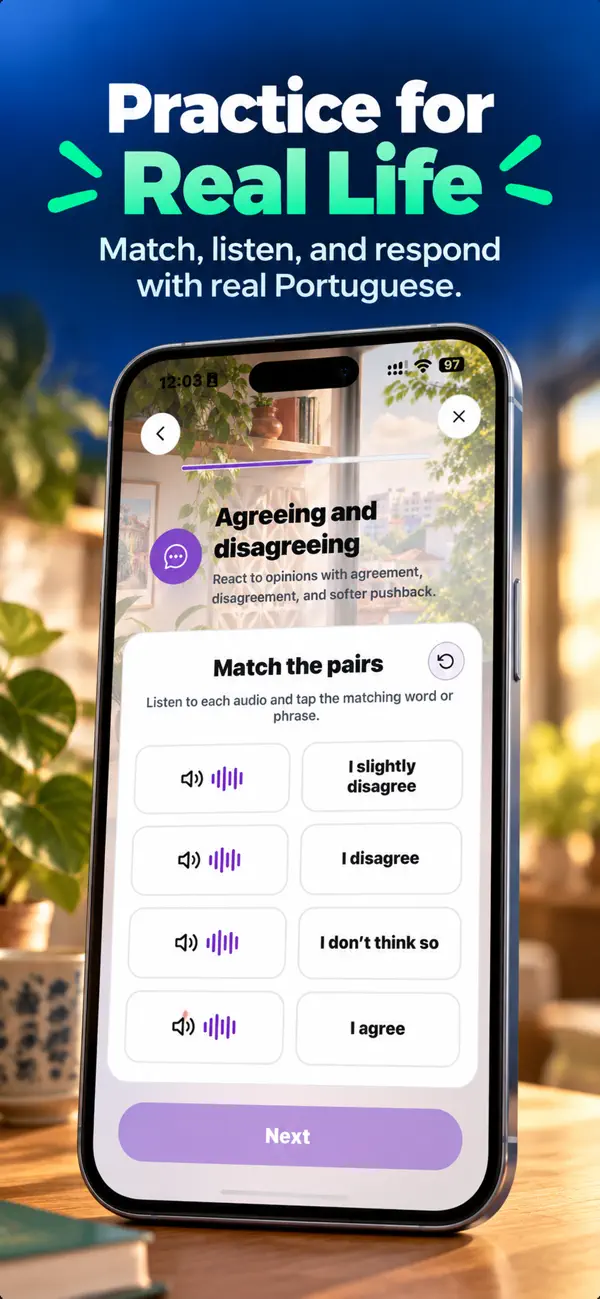
Short lessons and real conversations help you take what you learn into everyday Portuguese.